Building Intention Horizon with Claude Design, Claude Code, and the Screenplay Pattern
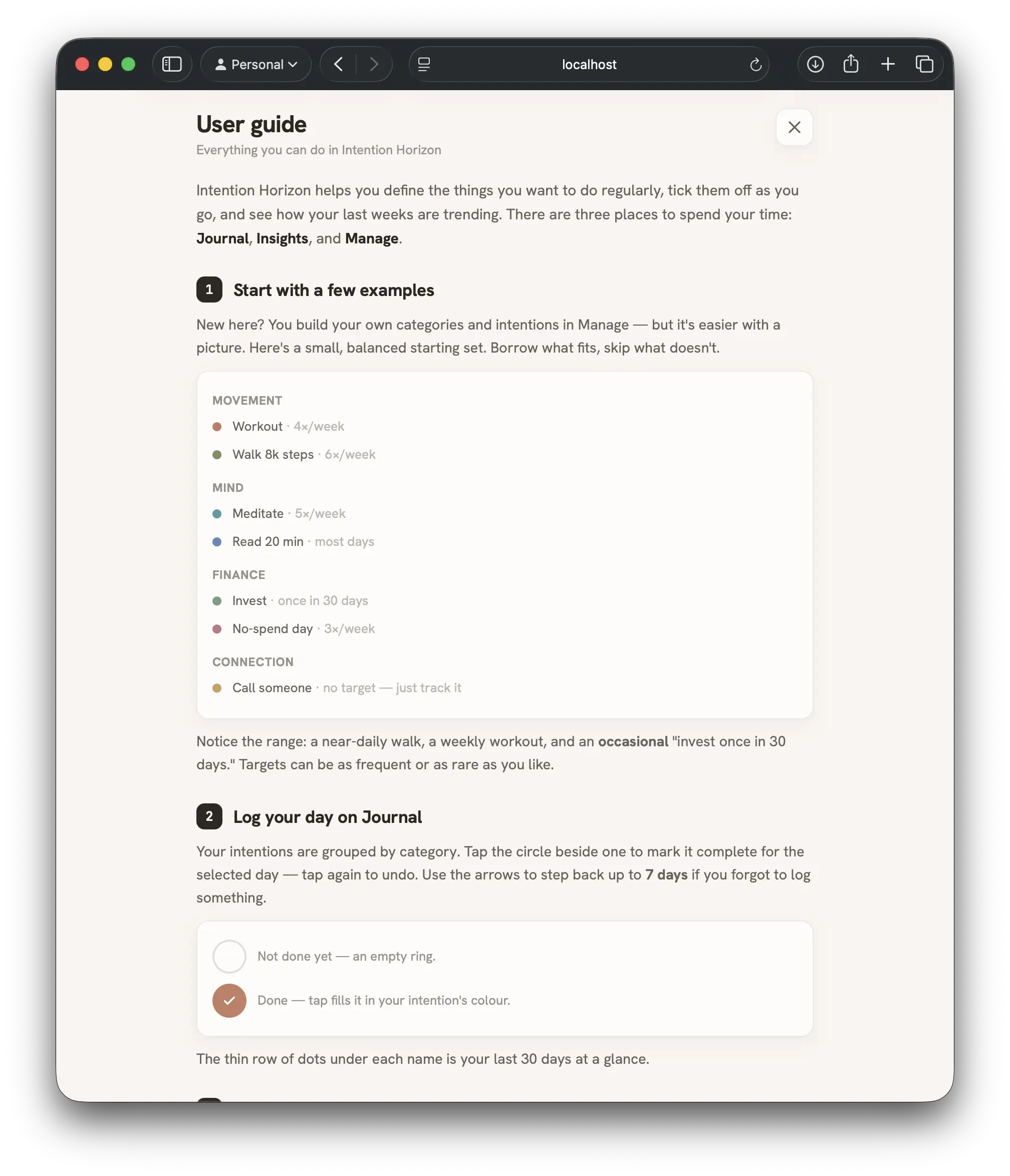
I built Intention Horizon as a sample app — something concrete to point at when discussing how to build software with AI. It’s a local-first habit tracker: define intentions, group them by category, tick them off each day, and watch your count move against a target you set — N completions over M days. React PWA, IndexedDB via Dexie, no backend. That made it a good test bed: small enough to finish, real enough to have edge cases.
The design handoff is where tools win or lose
I started in Stitch . It produced a reasonable UI. The problem came at handoff — pushing it into Antigravity didn’t give me a good result. That may be on me; there’s probably a better way to drive that path. But I wasn’t going to fight tooling for a sample app.
Claude Design and Claude Code, by contrast, were a breeze. Nice UI, and it converted to working code with almost no friction. The flow:
- Build the UI in Claude Design .
- Export it via the handoff feature — download the zip.
- Drop the zip into the Claude Code project.
- Paste the recommended conversion prompt.
That produced JSX. I then asked Claude Code to convert it to TypeScript, which became its own tracked change. The lesson isn’t “Claude good, other tool bad” — it’s that the export-and-handoff seam is the thing that matters. A design that exports as a clean artifact you can hand an agent beats a prettier design that doesn’t.
OpenSpec for evolving requirements
Once the UI was real code, requirements started moving — which is the normal state of any project. I drove those changes through OpenSpec : each change is a spec proposed, implemented, then archived. The archive tells the story:
migrate-to-typescript
add-url-routing
flexible-completion-target
add-data-source-toggle
default-real-gate-mock
insights-sort-recent-first
add-e2e-playwright-screenplay
refactor-e2e-serenity-screenplay
add-serenity-reports
...
Each is a discrete, reviewable unit of intent rather than a vague chat instruction. The win is that an AI agent works far better against a written spec than against “make it do X” — the spec is the shared contract, and the diff can be checked against it.
End-to-end tests: Screenplay over Page Objects
The e2e layer uses Playwright driven through Serenity/JS , structured with the Screenplay pattern. The spec reads as a script of a person performing a flow:
describe('Logging a completion', () => {
  it('marks the intention done and bumps its 7-day count', async ({ actor }) => {
    await actor.attemptsTo(
      Ensure.that(CompletionState.of('Read'), isFalse()),
      Ensure.that(WindowCount.forTarget('Read'), equals(3)),

      LogIntention.named('Read'),

      Ensure.that(CompletionState.of('Read'), isTrue()),
      Ensure.that(WindowCount.forTarget('Read'), equals(4)),
    );
  });
});
Why Screenplay
Page Object tests answer “what’s on the page.” Screenplay tests answer “what is the user doing.”
- Reads as a user journey. An actor — named Tess —
attemptsToa sequence of Tasks. The test is living documentation, not a pile of selector calls. - One responsibility per layer. Locators live in
elements.ts, user actions intasks.ts, state reads inquestions.ts. Specs compose Tasks and Questions and never touch a selector. - A change is a one-line edit. When a
data-testidmoves, you edit one locator. When a flow changes, you edit one Task. The blast radius is small. - Failures point at the user step. A break surfaces as “the user couldn’t log ‘Read’,” not as a null selector buried three helpers deep.
The cost is one extra layer — you write Tasks and Questions instead of calling the page directly. The payoff is that selectors, interactions, and assertions each live in exactly one place and compose. For an AI-assisted codebase that’s a strong fit: the agent extends the suite by adding a Task or a Question against clear boundaries, instead of hand-threading selectors through every spec.
Wait.until(form, not(isVisible()))), never a fixed sleep. That discipline is what keeps the suite stable and the edits one-line.Why Serenity/JS
Serenity gives more than a Screenplay API:
- Narrative reporting. Every Task carries a human description (
#actor logs "Read"), so the console and BDD reports read as plain-English steps — useful to non-engineers and as a record of what’s actually covered. - Rich Playwright integration. The
BrowseTheWebWithPlaywrightability wraps Playwright, so you keep its speed and reliability while gaining Screenplay structure on top. - Composable interactions and assertions.
Click,Enter,Wait,Ensure,Attribute,Textcompose into Tasks and Questions with consistent semantics. - Living documentation as an artifact.
serenity-bdd rungenerates a report from the run —npm run e2e:reportdoes exactly this — turning the test suite into browsable evidence of behavior.
Determinism comes from a seed injected onto window before the app boots, gated behind a DEV flag so production never sees it. Each test gets a fresh browser context and a known dataset, so date-window math is correct on any run date.
An example e2e test which is extremely readable:
import { describe, it } from '../fixtures';
import { Ensure, contain, not } from '@serenity-js/assertions';
import { GoToTab, AddIntention, EditIntention, DeleteIntention } from '../tasks';
import { IntentionList } from '../questions';

describe('Managing intentions', () => {
  it('creates, renames, and deletes an intention', async ({ actor }) => {
    // create on Manage, see it on Today
    await actor.attemptsTo(
      GoToTab.to('settings'),
      AddIntention.named('Floss'),
      GoToTab.to('entry'),
      Ensure.that(IntentionList.names(), contain('Floss')),
    );

    // rename on Manage, see the new name on Today
    await actor.attemptsTo(
      GoToTab.to('settings'),
      EditIntention.rename('Floss').to('Floss nightly'),
      GoToTab.to('entry'),
      Ensure.that(IntentionList.names(), contain('Floss nightly')),
      Ensure.that(IntentionList.names(), not(contain('Floss'))),
    );

    // delete on Manage, gone from Today
    await actor.attemptsTo(
      GoToTab.to('settings'),
      DeleteIntention.named('Floss nightly'),
      GoToTab.to('entry'),
      Ensure.that(IntentionList.names(), not(contain('Floss nightly'))),
    );
  });
});
The e2e suite can be easily run with npm run e2e:
✓ Execution successful (4s 918ms)
================================================================================
Execution Summary

Analytics correctness:     1 successful, 1 total (1s 957ms)
Date navigation:           4 successful, 4 total (4s 578ms)
Insights tab:              1 successful, 1 total (783ms)
Intention targets:         2 successful, 2 total (4s 605ms)
Logging a completion:      2 successful, 2 total (2s 652ms)
Managing categories:       2 successful, 2 total (6s 842ms)
Managing intentions:       1 successful, 1 total (4s 918ms)
Persistence across reload: 2 successful, 2 total (3s 437ms)

Total time: 29s 772ms
Real time: 9s 637ms
Scenarios:  15
================================================================================

  15 passed (10.2s)
For the full output see https://github.com/prule/intentionhorizon/blob/main/sample-e2e-run.txt
How the app works, and what you get from it
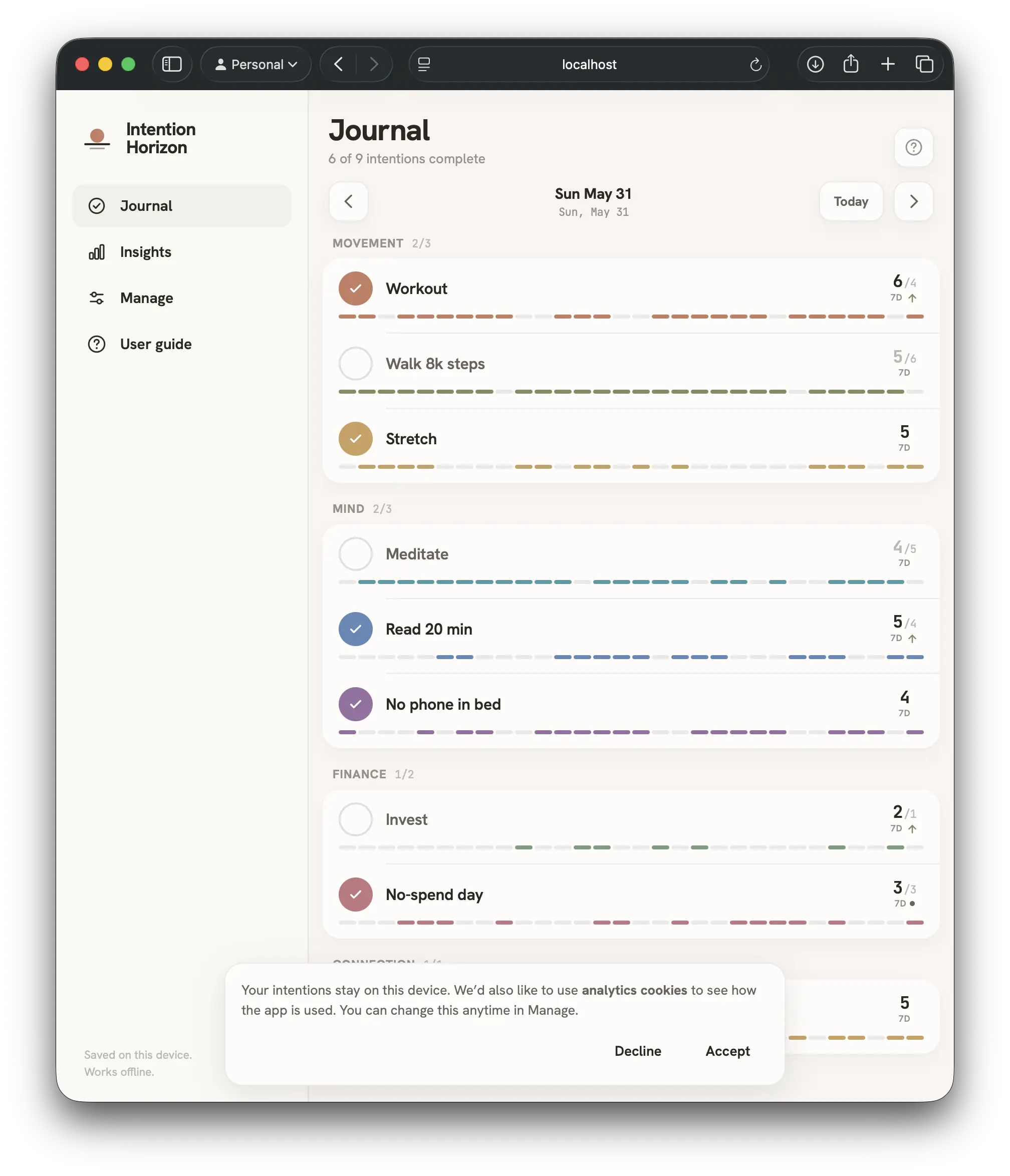
- Daily entry. Intentions grouped by category (Exercise, Finance, Focus). Toggle completion for today, and scroll back through a trailing window to fill in or review prior days. Each row shows a single live stat: completions in the trailing target period versus the target.
- Flexible targets with status. Set one optional target per intention — N completions over M days (e.g.
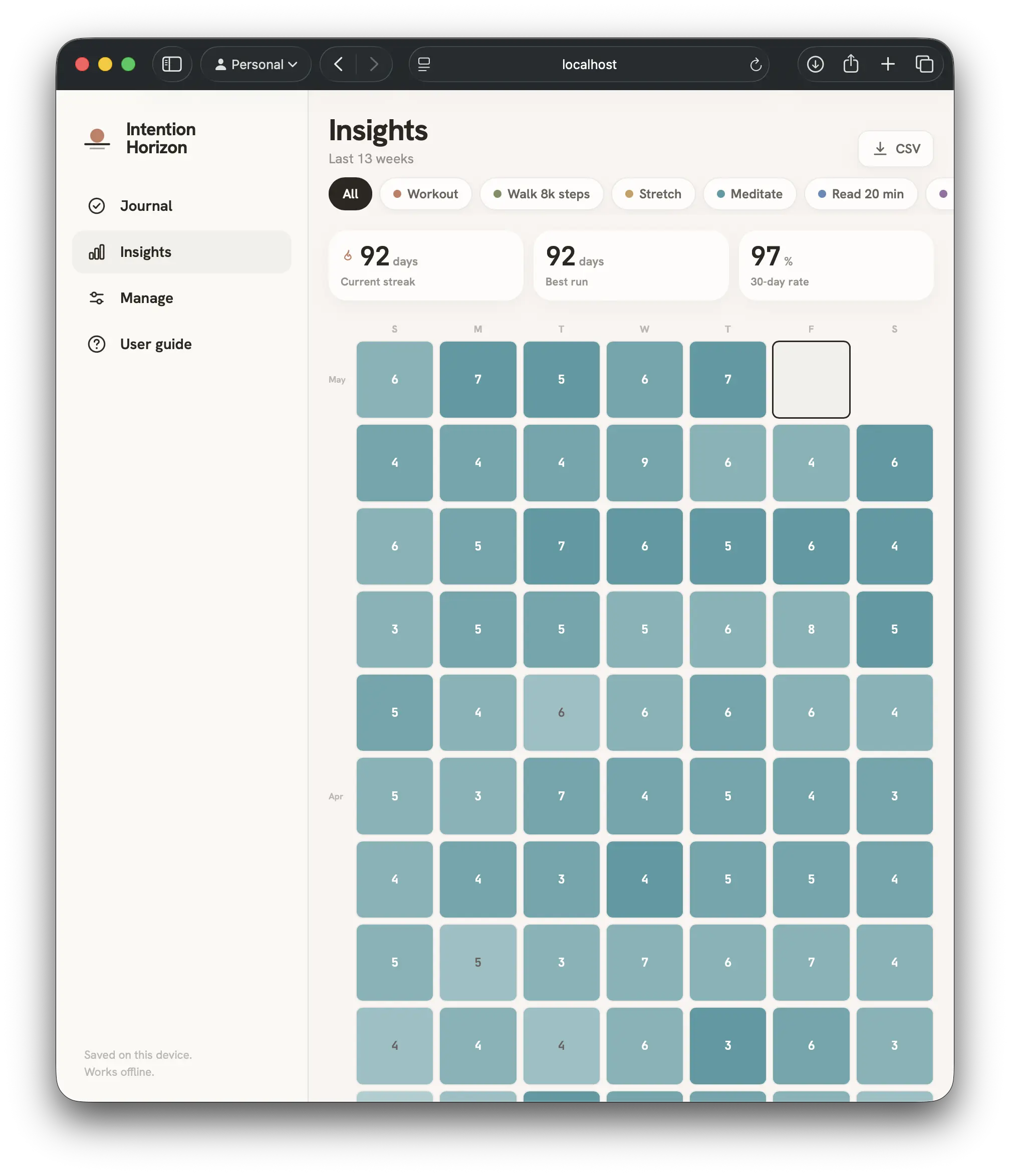
3× per 7 days), which covers everything from “once a year” to “twice a fortnight” with one concept. The current count renders under / on / over target, so a glance tells you where you stand — no mental arithmetic. - Analytics. A 7-column consistency grid (one per weekday) shades by how many intentions hit target, plus month-over-month trends and streak insights.
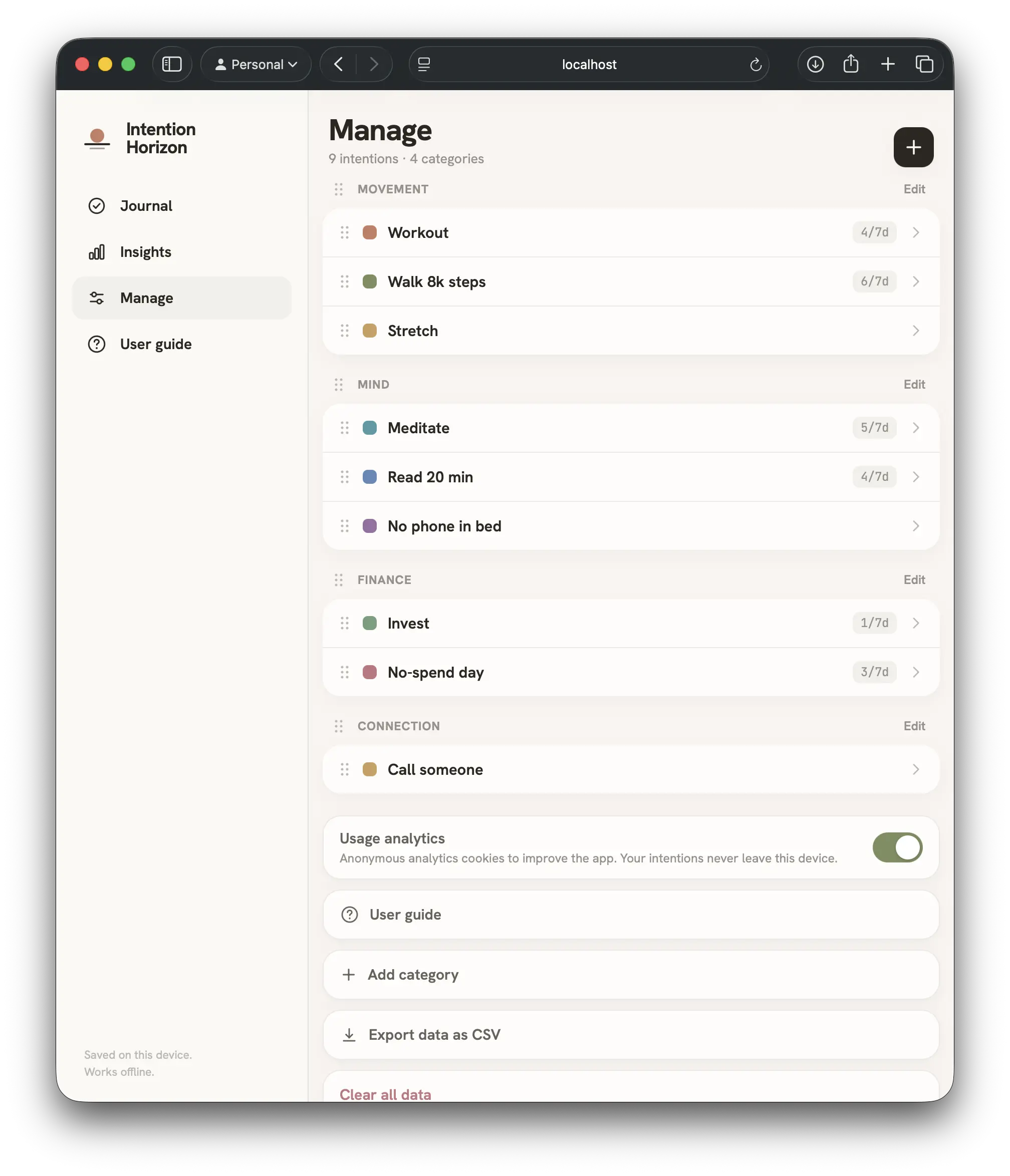
- Local-first and portable. Everything is stored in IndexedDB on your device — private by default, no account — and exportable to CSV whenever you want your data out.
The user benefit is the design intent: low-friction, high-density, honest feedback. It’s built for people who want data-driven self-improvement without gamification or decoration — define what matters, record it in seconds, and see consistency at a glance.
What carried the project
- A design tool that exports a clean handoff artifact an agent can consume — that seam decided the whole project.
- JSX first, TypeScript second — sequence the migration so each diff has one kind of error.
- OpenSpec to turn moving requirements into discrete, reviewable changes an agent can implement against a contract.
- Screenplay + Serenity/JS to get e2e tests that read as user journeys, localize change to one layer, and double as living documentation.
None of these are AI-specific tricks. They’re ordinary good practice — clean handoffs, typed code, written specs, layered tests. What AI changes is the cost of following them: with the seams in place, Claude Code did the mechanical work, and I spent my time on intent.
Screen shots
If you enjoyed this article, feel free to support my work on Ko-fi!
Support on Ko-fi